Requirements Management Use Case
In medical device development, maintaining clear traceability from initial requirements through design and verification is crucial for regulatory compliance. The Requirements Management Use Case helps you maintain compliance with ISO 13485 and FDA QSR standards by providing a structured approach to requirements management.
How Requirements Management Works
The Requirements Engineering Use Case provides a systematic approach to capturing, managing, and verifying requirements for your medical device. It ensures compliance with regulatory standards while maintaining clear traceability from user requirements through design output to verification and validation, supporting a structured development process.
KU/KTs

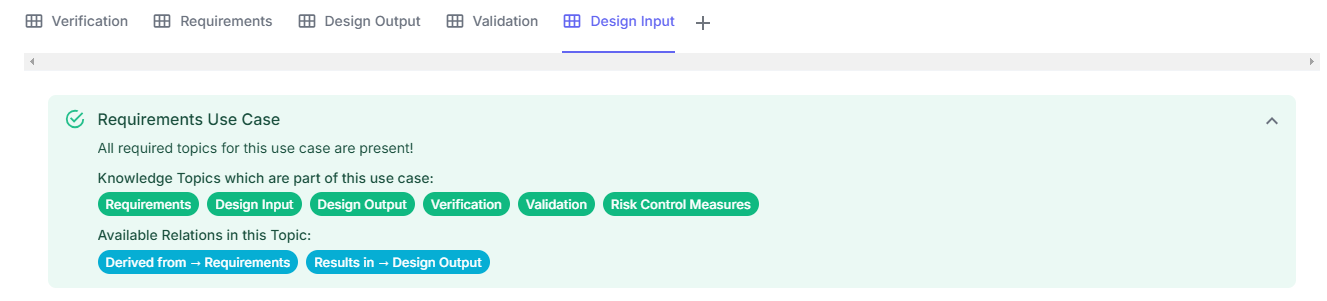
The Requirements Engineering use case in CertHub includes the following key components:
Required Knowledge Topics:
- User Requirements – The needs and expectations of the end-users.
- System Requirements – The functional and non-functional requirements for the entire system.
- Design Output – The result of the design process that implements the requirements.
- Verification – Ensures that requirements and design outputs meet specified criteria.
- Validation – Confirms that the final system or product meets user needs and intended use.
- Risk Control Measures – Actions or processes implemented to reduce risk, often basis for requirements.
Optional Knowledge Topics:
- Component Requirements – Requirements for an individual component, derived from system requirements.
- Unit Requirements – Requirements for an individual unit, derived from component requirements.
- Hardware Requirements – Requirements for the hardware of the device, derived from system requirements.
- Use Scenarios – Descriptions of how the device is used, from which requirements are derived.
Defining Relationships in Requirements Management
The diagram shows how the Knowledge Topics of this use case are connected. An arrow points from the source to the target Knowledge Topic. An arrow with two arrowheads marks a bidirectional relationship.
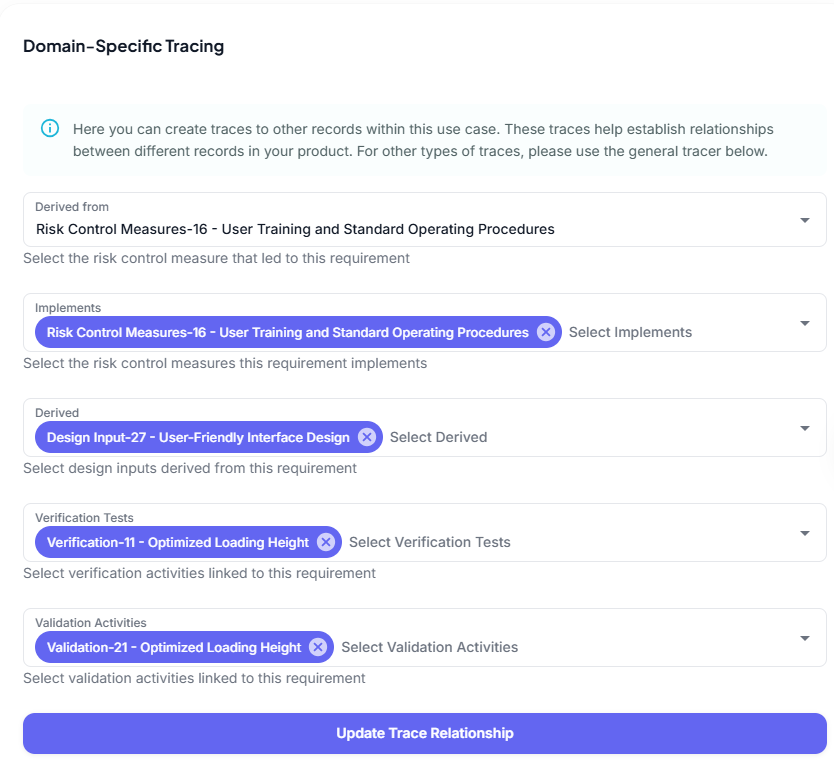
Each Knowledge Topic (KT) can have different relationships defined within the use case configuration.
| Source Knowledge Topic | Relation Name | Target Knowledge Topic | Allow Multiple | Description |
|---|---|---|---|---|
| User Requirements | Relates to | Risk Control Measures | Yes | Select the risk control measure that are related to this requirement. |
| Derived from | Use Scenarios | Yes | Select the use scenario that led to this requirement. | |
| Validated By | Validation | Yes | Select validation activities linked to this requirement. | |
| Leads to | System Requirements | Yes | Select system requirements that were derived from this user requirement. | |
| System Requirements | Derived from User Requirement | User Requirements | Yes | Select the user requirement that led to this system requirement. |
| Derived from Use Scenario | Use Scenarios | Yes | Select the use scenario that led to this requirement. | |
| Derived from RCM | Risk Control Measures | Yes | Select the risk control measure that led to this requirement. | |
| Results in | Component Requirements | Yes | Select the component requirements that were derived from this system requirement. | |
| Verified By | Verification | Yes | Select verification activities linked to this requirement. | |
| Hardware Requirements | Derived from | System Requirements | Yes | Select the system requirements that led to this hardware requirement. |
| Results in | Component Requirements | Yes | Select the component requirements that were derived from this hardware requirement. | |
| Component Requirements | Derived from | System Requirements | Yes | Select the system requirements that led to this component requirement. |
| Derived from * | Hardware Requirements | Yes | Select the hardware requirements that led to this component requirement. | |
| Related to | Risk Control Measures | Yes | Select the risk control measure that led to this requirement. | |
| Results in | Unit Requirements | Yes | Select the unit requirements that were derived from this component requirement. | |
| Verified by | Verification | Yes | Select the verification activities that verified this component requirement. | |
| Unit Requirements | Derived from Component Requirements | Component Requirements | Yes | Select the component requirements that led to this unit requirement. |
| Derived from RCM | Risk Control Measures | Yes | Select the risk control measure that led to this requirement. | |
| Verified By | Verification | Yes | Select the verification activities that verified this unit requirement. | |
| Design Output | Relates to SR | System Requirements | Yes | Select the system requirements that are related to this design output. |
| Relates to CR | Component Requirements | Yes | Select the component requirements that are related to this design output. | |
| Relates to UR | Unit Requirements | Yes | Select the unit requirements that are related to this design output. | |
| Verified By | Verification | Yes | Select verification activities ensuring compliance. | |
| Validated By | Validation | Yes | Select validation activities ensuring compliance. | |
| Related to HWR * | Hardware Requirements | Yes | Select the hardware requirements that are related to this design output. | |
| Verification | Verifies SR | System Requirements | Yes | Select the system requirements verified by this activity. |
| Verifies CR | Component Requirements | Yes | Select the component requirements verified by this activity. | |
| Verifies UR | Unit Requirements | Yes | Select the unit requirements verified by this activity. | |
| Verifies DO | Design Output | Yes | Select design outputs verified by this activity. | |
| Risk Control Measures | Implemented By | System Requirements | Yes | Select requirements that implement this control measure. |
| Verified By | Verification | Yes | Select verification activities ensuring control measure effectiveness. | |
| Validated By | Validation | Yes | Select validation activities confirming control measure suitability. | |
| Validation | Validates | User Requirements | Yes | Select the user requirement validated by this activity. |
| Validates DO | Design Output | Yes | Select design outputs validated by this activity. | |
| Use Scenarios | Related User Requirement | User Requirements | Yes | Select the user requirements related to this use scenario. |
| Related System Requirement | System Requirements | Yes | Select the system requirements related to this use scenario. |
* The relations from Component Requirements and Design Output to Hardware Requirements are only available if your product contains the Hardware Requirements Knowledge Topic.
All relations listed above are bidirectional: creating a link on one side automatically makes it visible on the related Knowledge Topic as well.
Concrete Example
A specific identified User Requirement is saved like this:
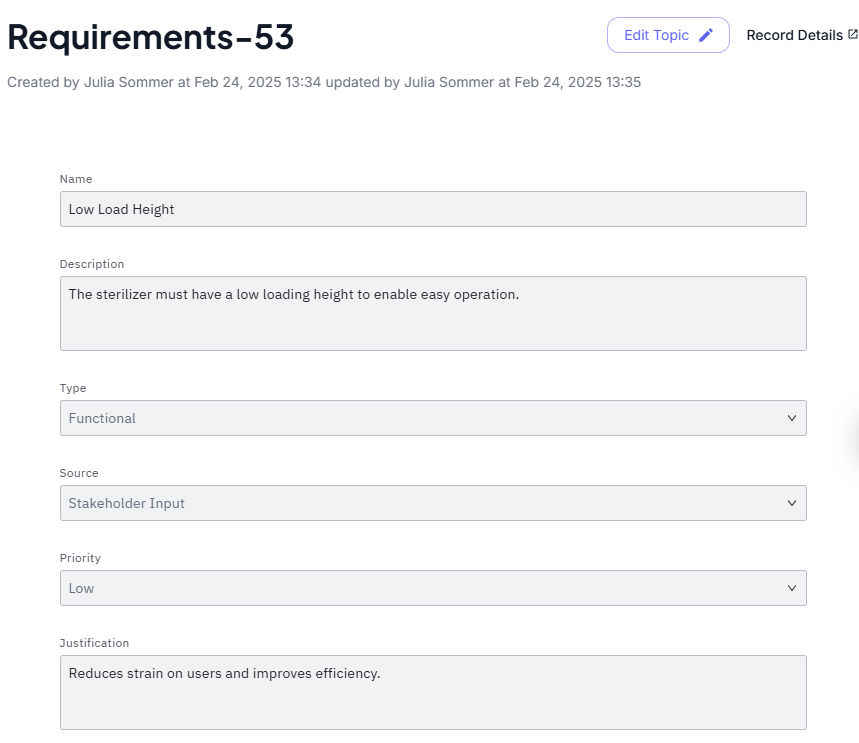
This, for example, is a concrete instance that can have a relationship to a specific Risk Control Measure, Use Scenario, Validation and System Requirement instance.
SOPs
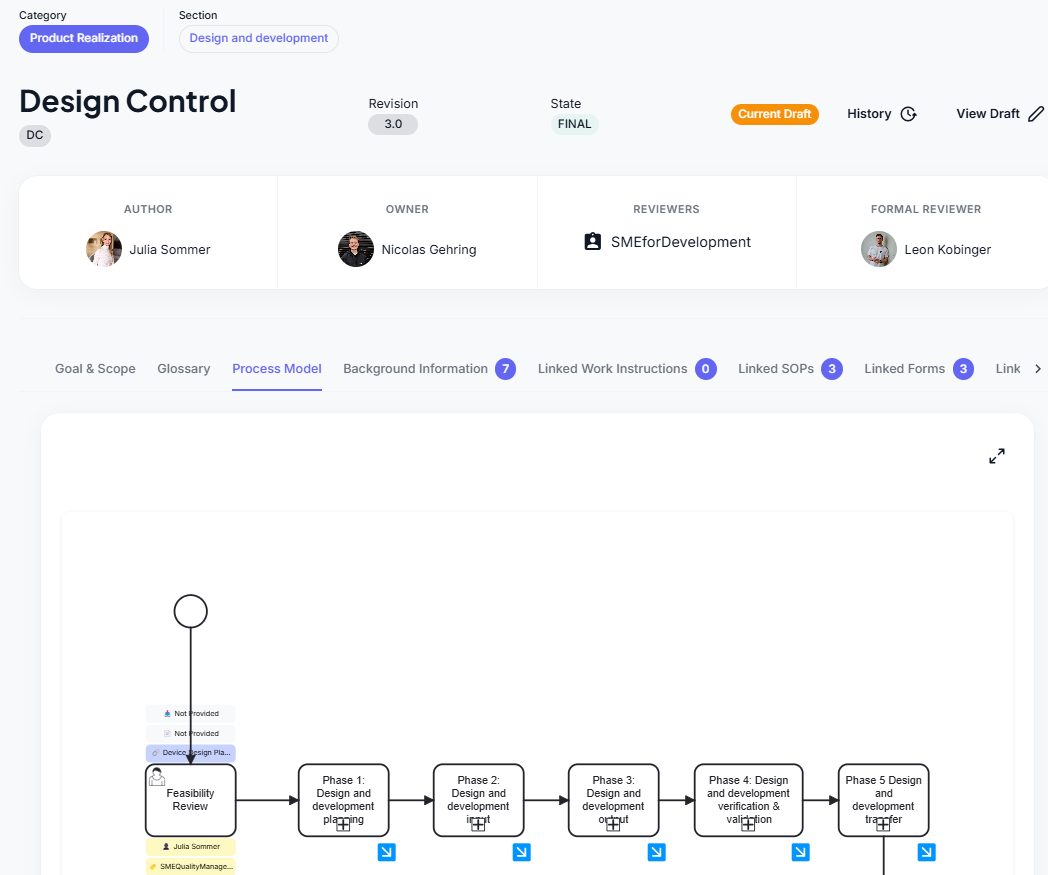
Requirements Engineering in CertHub follows a structured process:
- 🔍 Device Control Process – Defines how requirements are managed throughout the device lifecycle, ensuring compliance and safety.
Regulatory Compliance
The Requirements Management Use Case helps satisfy key regulatory requirements:
- ✅ ISO 13485:7.3 Design and Development
- ✅ FDA 21 CFR 820.30 Design Controls
- ✅ EU MDR Article 10 General Obligations
By following the structured approach provided by this Use Case, you can demonstrate complete requirements traceability during regulatory audits.
Integration with Other Use Cases
Knowledge Topics that belong to more than one use case connect those use cases. This use case shares Knowledge Topics with:
- Active Device – Risk Control Measures
- Essential Performance – System Requirements, Verification
- General Use Case – User Requirements
- Risk Management – Risk Control Measures, Verification
- Software Engineering – System Requirements, Design Output, Risk Control Measures
- Summative Evaluation – Use Scenarios
- Usability Engineering – Use Scenarios
By reusing shared KTs, CertHub makes integrating different use cases seamless and efficient, ensuring smooth traceability across processes.
Have a look at the Risk Management Use Case for more information on how the Risk Control Measure is used.